


Top Cybersecurity Best Practices for Small Businesses


Small businesses have become one of the most targeted groups online — not because they're more valuable than large enterprises, but because they're often easier to breach. Limited IT budgets, fewer dedicated security staff, and a false sense of "we're too small to be a target" leave many small businesses exposed to threats that are increasingly automated and, thanks to AI, increasingly convincing.
The good news: most of these attacks are preventable. You don't need an enterprise security team to significantly reduce your risk — you need the right layers of protection in place, configured correctly, and monitored consistently. That's where ESG IT Consulting comes in.
Understanding the Threat Landscape
Before diving into best practices, it helps to understand what you're actually up against. Small businesses today face a handful of recurring threat categories:
Phishing and social engineering — Still the most common entry point for attackers. A convincing email, text, or phone call tricks an employee into handing over credentials or clicking a malicious link. AI has made these attempts harder to spot, with more polished, personalized messages than the obviously fake emails of years past. More details here.
Ransomware — Attackers encrypt your files and demand payment to restore access. Even when a ransom is paid, there's no guarantee of full recovery, and downtime alone can be costly.
Weak or reused passwords — Without multi-factor authentication, a single leaked password (often from an unrelated breach) can be enough to compromise a business account.
Unsecured or outdated network equipment — Consumer-grade routers, unpatched firmware, and flat networks with no segmentation give attackers an easy path once they're inside.
Malicious or inappropriate web content — Employees browsing unrestricted, unfiltered internet access can unintentionally expose your network to malware, drive-by downloads, or compromised sites.
None of this is meant to be alarming for its own sake — it's meant to make clear why layered protection, not a single tool, is what actually keeps a business safe.
Industry Best Practices Every Small Business Should Follow
While no single fix eliminates risk entirely, a few foundational habits go a long way:
Turn on multi-factor authentication (MFA) everywhere it's supported. It's one of the single most effective ways to stop automated account takeover attempts.
Keep backups — and keep them offline or isolated. A ransomware attack is far less damaging when you can restore from a clean backup instead of paying a ransom. Read up on the Importance of Data Backup
Patch and update consistently. Outdated firmware and software are one of the easiest ways in for attackers.
Segment your network. Guest Wi-Fi, employee devices, security cameras, and point-of-sale systems shouldn't all sit on the same flat network.
Train your team. Regular, simple awareness training on phishing and social engineering pays for itself many times over.
Monitor, don't just install. Security tools only work if someone is watching what they flag and acting on it.
Most small businesses have at least some of these pieces in place. The gap is usually in consistency, monitoring, and having the right equipment to support it all — which is exactly where a managed IT partner adds value.
How ESG IT Consulting Helps Close the Gap
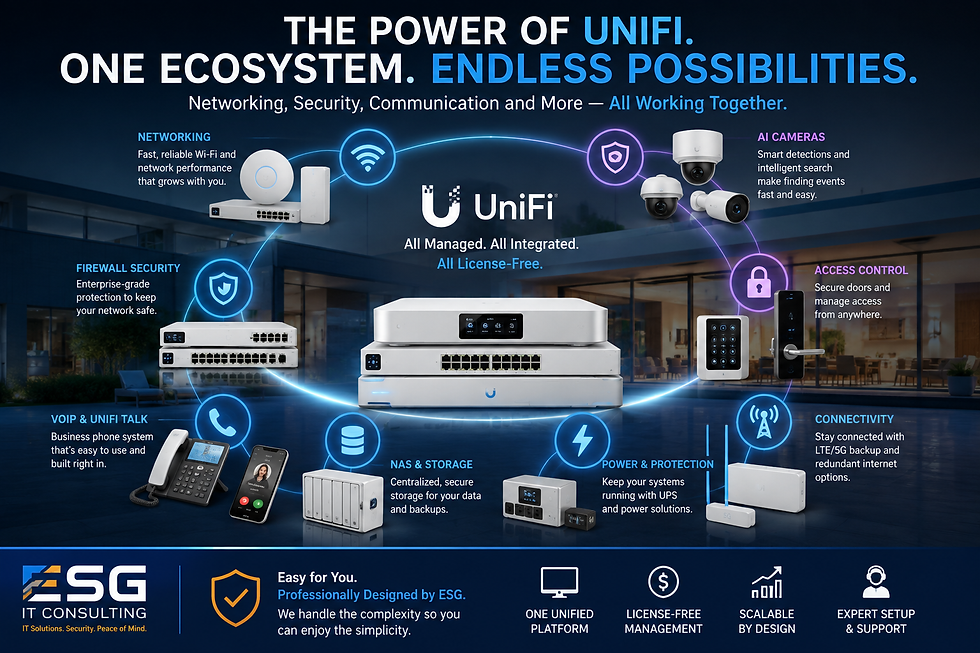
We build small business security around the UniFi ecosystem, layered with enterprise-grade threat intelligence:
UniFi Cloud Gateways form the foundation — a single, unified platform to manage your firewall, network segmentation (Learn more here.), VPN, and traffic policies, instead of stitching together separate consumer-grade devices with no central visibility. To learn more about UniFi, check out The Benefits of Switching to UniFi: One Ecosystem for Your Entire Home or Business.
UniFi CyberSecure, Enhanced by Proofpoint upgrades your gateway's built-in intrusion detection and prevention with a continuously updated library of threat signatures, sourced from Proofpoint's threat intelligence. In practice, this means your network is actively scanned for known attack patterns and malicious traffic in real time, with new threat signatures added weekly as new attack methods emerge.
Cloudflare-powered content filtering (bundled into CyberSecure Enhanced) adds granular, policy-based control over what websites and content categories your network can access — blocking malicious, adult, or otherwise unwanted domains before they ever reach an employee's screen.
Layered together, these tools give a small business a level of protection that would traditionally require an in-house security team — without the in-house security team. But tools alone aren't a strategy. We handle the configuration, the monitoring, and the ongoing tuning so these protections are actually working in the background, not just sitting on a shelf.
You Don't Have to Navigate This Alone
Understanding the risks is a good first step — but building and maintaining the right defences takes experience, the right tools, and ongoing attention that most small businesses simply don't have the internal bandwidth for. That's the gap ESG IT Consulting exists to fill.
If you're not sure how well-protected your business currently is, or you want to talk through what a layered security setup — UniFi, CyberSecure, and Cloudflare included — would look like for your business, we're happy to walk through it with you.
Contact us to schedule a conversation about securing your network.
Frequently Asked Questions
What is the most important cybersecurity protection for a small business? There isn't a single silver bullet, but if you can only prioritize one thing, make it multi-factor authentication (MFA). It directly stops the most common way accounts get compromised — stolen or guessed passwords — and it's one of the fastest, lowest-cost protections to put in place. From there, a properly configured firewall/gateway, regular backups, and employee awareness training round out the essentials.
Is a small business really a target for hackers? Yes — often more so than large enterprises. Attackers know small businesses tend to have valuable data (customer records, payment info) but weaker defences than a large company, making them a more accessible target. Being small doesn't make you invisible; it can actually make you more attractive to opportunistic attackers.
What is MFA and why does my business need it? MFA (multi-factor authentication) requires a second form of verification, like a code sent to your phone or an authenticator app, in addition to your password when logging in. Even if a password is stolen or leaked, MFA prevents an attacker from accessing the account without that second factor. It's a simple step that closes one of the most commonly exploited security gaps.
How often should a small business back up its data? Daily backups are a good baseline for most small businesses, with critical or frequently changing data backed up even more often. Just as important as frequency is where the backup lives; keeping a copy offline or isolated from your main network means that if ransomware hits, your backup isn't encrypted along with everything else. You should also test backups periodically to confirm they restore properly.
What is network segmentation? Network segmentation means splitting your network into separate zones instead of putting every device on one flat network. For example, guest Wi-Fi, employee workstations, security cameras, and point-of-sale systems can each sit on their own segment. If one segment is compromised, segmentation helps contain the damage instead of letting an attacker move freely across your entire network.
Does UniFi provide cybersecurity protection for small businesses? Yes. UniFi Cloud Gateways give you a centralized platform for your firewall, network segmentation, and traffic policies. On top of that, UniFi CyberSecure, Enhanced by Proofpoint, adds intrusion detection and prevention powered by continuously updated threat signatures, along with Cloudflare-powered content filtering to block malicious or unwanted web content. Together, they provide layered, enterprise-grade protection built specifically for the way small businesses actually operate.
How can ESG IT Consulting help protect my business? We design, configure, and manage your network security so you don't have to become a cybersecurity expert yourself. That includes setting up UniFi hardware and CyberSecure protections, configuring network segmentation, setting up reliable backups, and monitoring your systems on an ongoing basis — not just installing tools and walking away. If you want a clear picture of where your business currently stands, contact us, and we'll walk you through it.


Comments